This website uses cookies to ensure you get the best experience on our website. privacy policy and terms of use.
July 16, 2026
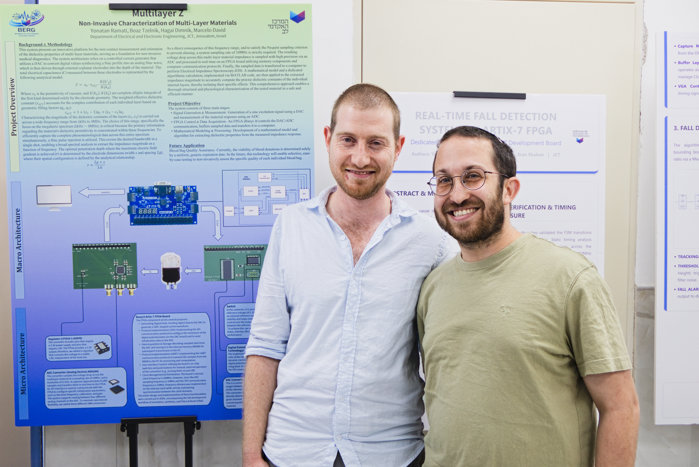
When Boaz Tzelnik stood beside his poster at JCT's first-ever joint Final Project Competition, few in the room could have guessed what it took for him to get there.
Boaz, an Electrical and Electronics Engineering student, was critically wounded during the war when his unit was caught in a terrorist ambush. He lost a massive amount of blood, and it was only through numerous blood transfusions that his life was saved. What followed was a long and grueling process of recovery and rehabilitation — and then, remarkably, a return to the classroom to complete his degree.
But Boaz didn't just come back to finish his studies. He came back with a mission.
The blood transfusions that saved his life inspired his choice of final project: a new method for testing the quality of donated blood units — without ever opening the bag — developed together with his project teammates.
Today, quality and expiration testing requires opening a blood bag and extracting a sample for laboratory analysis, a process that takes time and compromises the unit itself. The team's solution uses electromagnetic waves transmitted through the sealed bag to gather medical data about the blood inside — enabling rapid, non-invasive testing that keeps every precious unit intact and ready for the patient who needs it.
His motivation was simple: to transform the crisis he experienced into a development that could help others.
Boaz's teams project was among the standout entries at the competition, which for the first time brought together final projects from all engineering programs across JCT's Lev and Tal campuses, with students presenting their work in poster format. Many of the projects were developed in cooperation with industry and with professionals from Israel's defense and healthcare sectors.
The research, conducted under the supervision of Dr. Marcelo David, isn't stopping at the competition. Dr. David is working with Boaz to develop the work into an academic article expected to be published in a scholarly journal — the next step in bringing this innovation from the lab bench toward real-world impact.
Boaz's journey — from the battlefield, through rehabilitation, and back to the engineering lab — embodies what JCT stands for: students who transform personal challenge into technology that serves others.